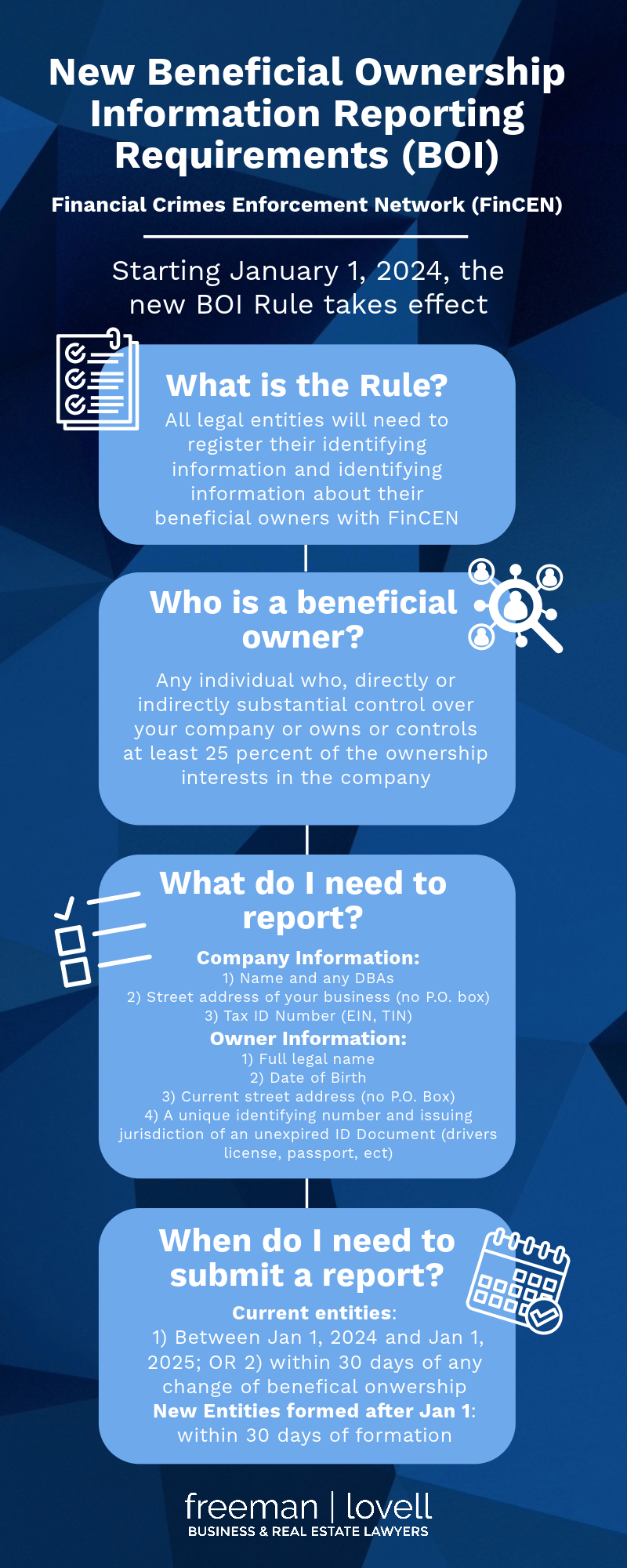
Starting January 1, 2024, a new rule took effect requiring all registered legal entities, including limited liability companies and corporations, to report their beneficial owners to the Financial Crimes Enforcement Network (FinCEN). We wanted to give you a heads up about the rule and give you as much information about what it means to you.
What is the rule?
The rule, which is called the Beneficial Ownership Information Reporting Requirements (BOI Rule), comes from the Corporate Transparency Act, which was passed by Congress in 2021. This law created the BOI Rule with FinCEN as part of the U.S. government’s efforts to make it harder for bad actors to hide or benefit from their ill-gotten gains through shell companies or other deceitful ownership structures. Under this new law, FinCEN will permit Federal, State, and local officials to obtain ownership information for authorized activities related to national security, law enforcement, and intelligence.
When does the rule take effect? And when do I have to submit a report?
The BOI Rule took effect on January 1, 2024. If your company existed before January 1, 2024, you must file its initial beneficial ownership information report by January 1, 2025. If your company is formed or registered after January 1, 2024, you must file its initial beneficial ownership information report within 90 days after receiving actual or public notice that its creation or registration is effective.
If any beneficial ownership information changes, you will have 90 days from the day of the change to file an updated or corrected report with FinCEN.
What if I don’t file a Report?
According to FinCEN:
“The willful failure to report complete or updated beneficial ownership information to FinCEN, or the willful provision of or attempt to provide false or fraudulent beneficial ownership information may result in a civil or criminal penalties, including civil penalties of up to $500 for each day that the violation continues, or criminal penalties including imprisonment for up to two years and/or a fine of up to $10,000. Senior officers of an entity that fails to file a required BOI report may be held accountable for that failure.”
What do I need to include in the report?
The BOI Rule requires that all entities report information about the company, each individual with substantial control over the entity, and each beneficial owner.
What information is required to report about the entity?
- Full legal name of your company and any DBAs names;
- Complete current street address for your company's principal place of business (P.O. boxes will not be accepted);
- The jurisdiction of formation or registration; and
- Tax identification:
- IRS tax identification number (TIN) and employer identification number (EIN).
What information is required to report about the controlling individuals and beneficial owners?
- The individual's legal name;
- Individual's date of birth;
- Individual's residential address; and
- A unique identifying number from an acceptable identification document (such as an unexpired driver's license, passport, identification document issued by a State or local government or Indian tribe) and the name of the issuing state or jurisdiction.
Who is considered to have substantial control of the entity?
Examples of an individual that exercises substantial control over the entity are:
- An individual is a senior officer (President, CEO, CFO, COO, Manager, or other office who performs a similar function);
- An individual has the authority to appoint or remove certain officers or a majority of directors of the reporting company;
- An individual is an important decision-maker for the company; or
- An individual has any other form of substantial control over the company.
Who is considered a beneficial owner?
A beneficial owner is an individual that owns or controls at least 25% of the entity’s ownership interests. This includes individuals that indirectly own or control 25% of the ownership interest. For example, if Joe is a 50% owner of Parent LLC, which in turn owns 50% of Subsidiary Corp, then Joe beneficially owns 25% of Subsidiary Corp (50% of 50% = 25%).
What type of entities will be required to file a report with FinCEN?
All domestically formed entities and foreign registered entities in the USA are required to file a report. Types of entities include corporations, limited liability companies, limited partnerships, general partnerships, and any other entity registered with a state Secretary of State or Division of Corporations or other similar office.
There are some types of companies that are exempt from the reporting rule, and in general they are companies that already have to report beneficial ownership to another federal agency. The 23 exemptions listed by FinCEN are: Securities reporting issuer, Governmental authority, Bank, Credit union, Depository institution holding company, Money services business, Broker or dealer in securities, Securities exchange or clearing agency, Securities exchange or clearing agency, Other Exchange Act registered entity, Investment company or investment adviser, Venture capital fund adviser, Insurance company, State-licensed insurance producer, Commodity Exchange Act registered entity, Accounting firm, Public utility, Financial market utility, Pooled investment vehicle, Tax-exempt entity, Entity assisting a tax-exempt entity, Large operating company, Subsidiary of certain exempt entities, and Inactive entity.
Can you help me with my company’s report?
Yes! We are happy to help prepare and file your company’s BOI Rule report with FinCEN before the December 31, 2024 deadline.
We offer a flat-fee service that is discounted based on how early you pay and submit your information.
Sign up for our BOI Rule report service HERE.
We also know that some situations can be complicated, so please feel free to ask us any questions regarding compliance with the beneficial ownership interest reporting requirements for your company by emailing teamjosh@freemanlovell.com.